Science & Education
What Mattress Certifications Can—and Cannot—Tell You: A Naturepedic Case Study
A label is a useful starting point, not a verdict. To understand what a mattress certification really means, identify who issued it, what its standard covers, and whether the claim applies to the complete mattress or only to particular materials and components.
Published November 4, 2026
Buying a mattress can feel like a lesson in decoding: organic, natural, low-emission, chemical-conscious. Labels and certification marks promise a shortcut through the claims. Some do provide meaningful evidence. But a certification is not a universal score for safety, comfort, durability, or environmental impact. It answers a narrower question, under a particular set of rules.
That distinction matters. A certification might address the fiber in a fabric, the ingredients in a foam, emissions from a finished product, or the processes used by a manufacturing facility. Those are not interchangeable claims. A mark on one component does not automatically certify every layer, accessory, or attribute of a mattress.
Naturepedic offers a useful case study because its product information describes several materials and references certification-related programs. The aim here is not to declare a mattress “good” or “bad,” or to treat any single label as proof of overall quality. It is to show how shoppers can follow a claim back to its source, examine its scope, and decide what the available evidence does—and does not—establish.
The first question: What exactly is being certified?
The word “certified” can sound comprehensive, as though an independent organization has inspected every aspect of a finished product. In practice, certification programs define their own boundaries. A standard may cover a material, a manufacturing step, a facility, a chemical-restriction list, or a finished item. The details are in the program’s rules, not in the emotional impression created by a logo.
Begin by turning a broad claim into a specific question. If a mattress is described as organic, ask which materials are organic and what standard verifies that claim. If it is described as low-emission, ask which emissions were assessed, under what test conditions, and whether the tested item was a component or the complete mattress. If a company says it avoids certain chemicals, look for the actual list and the scope of the policy.
This is the central habit of evaluating product certifications: replace the question “Is it certified?” with “Certified by whom, to which standard, for what, and when?” A clear answer is more informative than a collection of impressive-sounding badges.
Three checks for reading a certification claim
- Identify the certifier. Find the organization behind the mark and confirm that it operates a defined program. A brand’s own description is useful context, but it is not the same as independent verification.
- Read the scope. Check what the standard assesses: material content, chemical restrictions, emissions, manufacturing practices, or something else. Do not assume one result covers unrelated qualities.
- Match the claim to the product. Determine whether the certification applies to the finished mattress, a component, a facility, or a supplier. Look for the product name, model, certificate holder, and current status where the program provides them.
These checks are simple, but they prevent a common leap in reasoning: “This mattress contains a certified material, therefore the whole mattress has been certified for every quality I care about.” The conclusion may go well beyond the evidence.
A closer look at the Naturepedic example
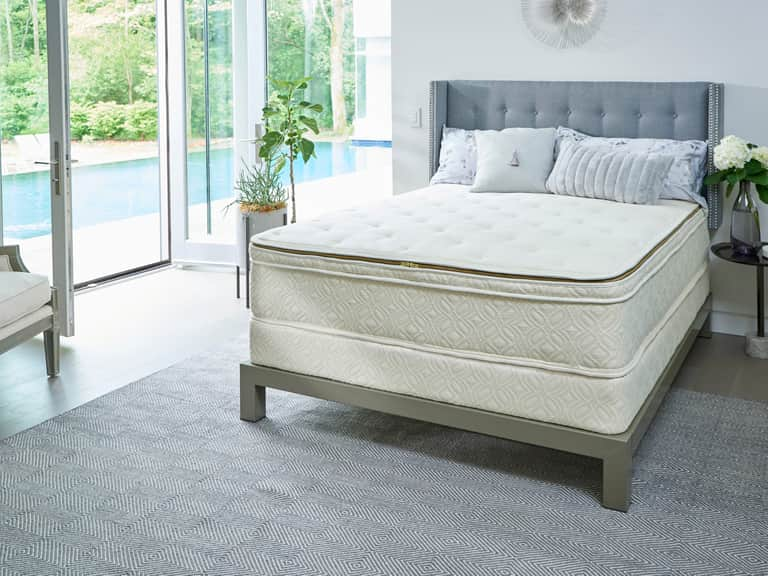
Naturepedic’s Elysium Hybrid Organic Mattress is described as a 15-inch mattress with two layers of wrapped coils, three inches of customizable organic Dunlop latex, and a quilted cover containing wool, alpaca, and cashmere. The product information also refers to GOTS-approved materials and presents certification-related marks associated with GOTS and GOLS, alongside an EWG Verified mark.
That description gives shoppers useful leads, but it does not answer every certification question by itself. The careful next step is to check the relevant program’s current public information and compare the certificate’s scope with the exact claim made about the mattress. A product page can summarize a certification; the program’s own documentation is where shoppers can investigate what the certification covers.
For example, a reference to “GOTS-approved materials” should prompt a more precise question: Which materials? What does “approved” mean in this context? Is there a current certification for the finished product or for particular textile components and supply-chain stages? The phrase alone does not establish that every part of the mattress—including coils, latex, thread, adhesives, or any other component—falls within the same certification scope.
Similarly, seeing GOLS mentioned in product information should lead to a component-level check. GOLS, the Global Organic Latex Standard, concerns organic latex and related processing and supply-chain requirements. It is not a general certification for every material in a mattress. A shopper would want to confirm whether the latex used in the specific model is covered and what the relevant certificate says.
Naturepedic’s product listing also refers to EWG Verified. That is a program administered by the Environmental Working Group, not a synonym for organic certification. Its criteria and claims should be read on their own terms. A mark associated with one program cannot be treated as proof of a different claim, such as organic fiber content or emissions performance.
What common mattress labels may address
Several standards and programs appear in mattress shopping. Their names may look like members of one family, but their purposes differ. Always consult the current standard and certificate details: requirements, eligible products, and program rules can change.
GOTS: organic textiles and processing
The Global Organic Textile Standard (GOTS) is a textile-processing standard with requirements that can address organic fiber content, processing, environmental criteria, and social criteria across covered stages of the supply chain. Its scope depends on the certified product and operation. A GOTS claim about a textile component should not be silently expanded into a claim that every non-textile part of a mattress is certified.
GOLS: organic latex
The Global Organic Latex Standard (GOLS) focuses on organic latex and requirements for relevant processing and supply-chain stages. It can help shoppers investigate a latex claim, but it does not assess comfort, mattress firmness, sleep outcomes, or the entire product’s environmental footprint.
EWG Verified: a separate product program
EWG Verified is a program with its own criteria and product review process. Its presence should be interpreted according to the program’s published requirements and the exact product listing. It is not interchangeable with GOTS or GOLS, and shoppers should avoid translating it into a blanket guarantee that a product is risk-free or suitable for every individual.
Emissions labels and chemical-restriction programs
Other labels may focus on emissions or restricted substances. These can be valuable, but the test method, limits, sample, and product category matter. A low-emissions result is not the same as a finding that a product contains no chemicals; all materials are made of chemicals, and the relevant question is which substances, at what levels, and under which conditions were evaluated.
The limits of a certification
Even a legitimate, current certification answers only the questions its standard was designed to address. It does not automatically establish that a mattress is the best choice for a particular sleeper, that it will last for a specified number of years, or that its manufacture had no environmental impact. Nor does a certification replace practical product information such as firmness, construction, dimensions, care instructions, warranty terms, and return policy.
Certifications are also not medical advice. A label should not be taken as proof that a mattress will treat allergies, prevent illness, or improve a medical condition. People with specific health concerns can discuss them with a qualified health professional and review product details relevant to their circumstances.
Another limitation is that certification status can be model-specific and time-sensitive. A company may have multiple products, suppliers, or production arrangements. One model’s certificate does not necessarily cover another model, and an old marketing page may not reflect a current certificate. Check the exact product and the date or validity information shown by the certifier.
How to verify a claim without becoming a detective
Verification need not become a research project. A few focused steps can establish whether a claim is clear enough to rely on:
- Copy the exact wording. Note whether the seller says “certified,” “made with certified materials,” “meets,” or “contains.” These phrases can describe different levels of evidence.
- Find the certifier’s own explanation. Use the organization’s official site to understand the standard and its boundaries, rather than relying only on a retailer’s summary.
- Search the public directory, if one exists. Match the product or certificate holder, not merely the brand name. Check for a current status and the scope of certification.
- Ask what is covered. If the public record is unclear, ask the manufacturer or seller which components are certified and whether documentation is available.
- Keep the conclusion proportional. If a certificate covers latex, say the latex is certified under that program—not that the entire mattress has been certified for every possible concern.
For Naturepedic, that means treating its product page as a map to claims worth checking, not as the final certification record. A shopper can compare the Elysium’s listed materials with current information from the relevant programs, then ask whether each mark applies to the latex, textiles, a manufacturing process, or the finished model. If the distinction is not explicit, it is reasonable to request clarification before treating a broad phrase as a product-wide assurance.
A quick framework for comparing mattresses
When comparing two products, make a small evidence table rather than counting labels. For each claim, write down the standard, the material or process it covers, and the evidence you found. This makes gaps visible and prevents a mattress with more logos from seeming automatically superior to one with clearer documentation.
| Question | What to look for |
|---|---|
| Who verifies the claim? | The certifier’s identity, program rules, and a way to check current status. |
| What does the standard cover? | A defined material, process, facility, emissions test, or finished product. |
| Which exact item is covered? | The model, component, supplier, or certificate holder named in the documentation. |
| What does the label not establish? | Any qualities outside the standard, including comfort, durability, medical benefit, or complete environmental impact. |
Then assess the mattress as a whole. Certifications can inform a decision about materials or manufacturing criteria, while construction and fit inform other parts of the purchase. In the Elysium description, for instance, the listed construction—wrapped coils, Dunlop latex, and a wool, alpaca, and cashmere blend—offers material and design information. It does not, by itself, tell every shopper whether the mattress’s feel, height, price, or support will suit their needs.
What a trustworthy claim sounds like
Good product communication is specific. It identifies the standard, says which material or product is covered, and points readers toward documentation. It distinguishes between “the cover is made with certified organic cotton” and “the entire mattress is certified organic,” rather than using the two phrases as if they mean the same thing.
Vague language is not proof of wrongdoing, but it is a reason to ask a better question. “Eco-friendly,” “clean,” and “non-toxic” can be difficult to evaluate without defined criteria. Ask what the company means, what evidence supports the wording, and whether an independent program verifies it. If the answer remains general, treat the claim as a marketing description rather than a precise certification result.
The bottom line
Mattress certifications are most useful when read narrowly and verified carefully. They can provide structured evidence about particular materials, processes, or product criteria. They cannot serve as a universal rating of a mattress, and a label on one component should not be mistaken for certification of the entire bed.
Naturepedic’s Elysium Hybrid Organic Mattress illustrates the right approach: start with the product’s stated materials and certification references, then check the relevant programs for current scope and product-specific documentation. Separate GOTS, GOLS, and EWG Verified claims rather than blending them into one broad assurance. Ask what each one evaluates, what it excludes, and which parts of the mattress it covers.
The result is not a perfect shortcut. It is better: a clear, evidence-based way to judge claims. The most meaningful label is not necessarily the one with the grandest promise, but the one whose scope is transparent—and whose limits are stated just as plainly.